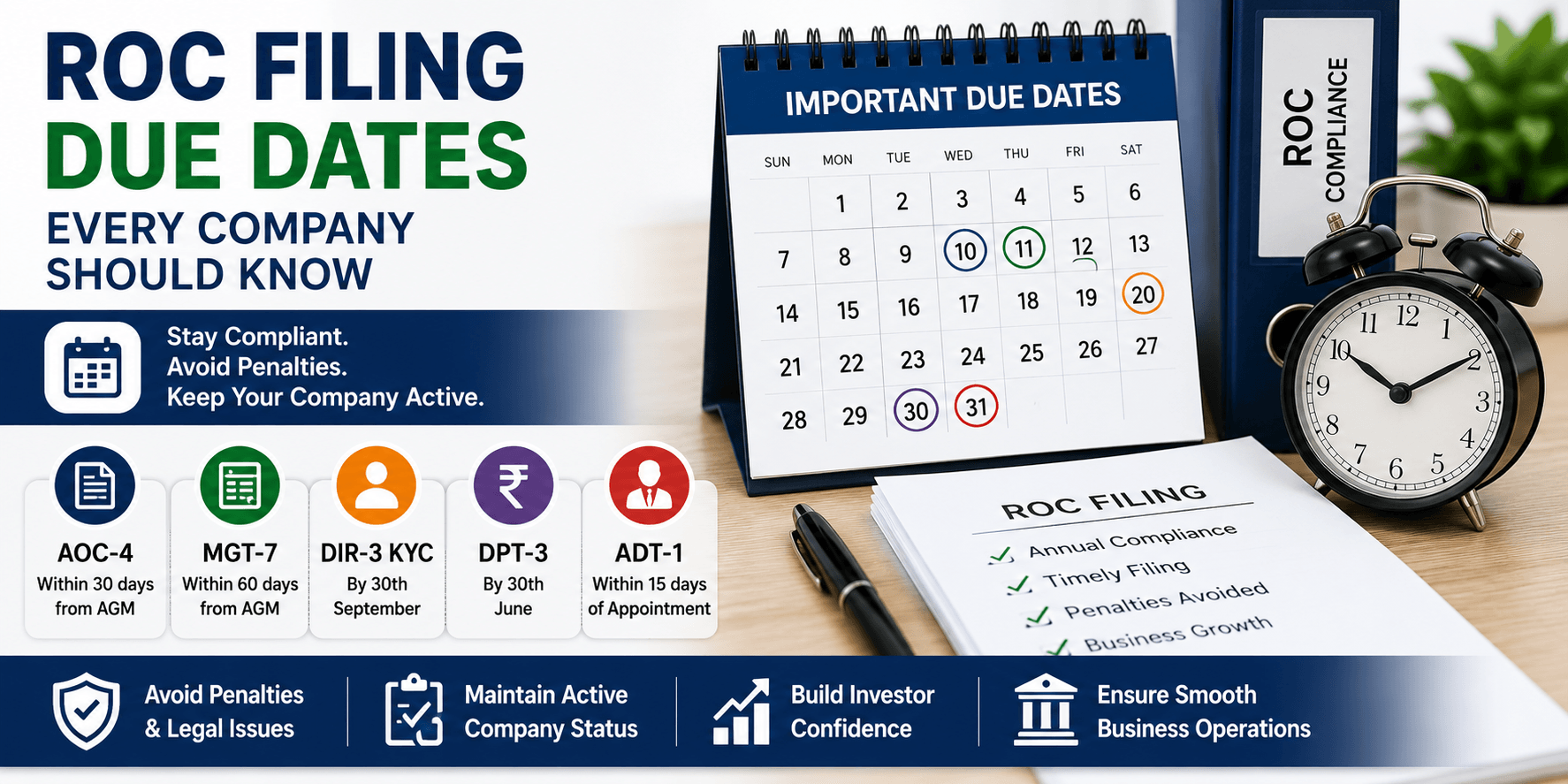
Running a company in India involves more than just business operations and revenue generation. Every company registered under the Companies Act must follow various ROC compliance requirements to avoid penalties, maintain legal status, and ensure smooth business operations.
Many startups, SMEs, and private limited companies unknowingly miss important ROC filing due dates, leading to:
- Heavy penalties
- Legal notices
- Director disqualification
- Compliance issues
Understanding ROC filing due dates is essential for maintaining proper corporate compliance in India.
In this article, we will discuss the important ROC filing due dates every company should know, along with the significance of MCA compliance, annual filing requirements, and how businesses can avoid penalties.
What is ROC Filing?
ROC filing refers to submitting various forms and compliance documents to the Registrar of Companies (ROC) under the Ministry of Corporate Affairs (MCA).
These filings include:
- Annual returns
- Financial statements
- Director disclosures
- Company compliance forms
ROC compliance is mandatory for:
- Private Limited Companies
- One Person Companies (OPCs)
- LLPs
- Public Limited Companies
Even inactive companies must complete certain ROC filings.
Why ROC Filing is Important
Proper ROC compliance helps businesses:
- Maintain active company status
- Avoid legal penalties
- Improve corporate governance
- Build investor confidence
- Ensure financial transparency
Non-compliance may lead to:
- Heavy late filing fees
- Company penalties
- Director disqualification
- Legal complications
For startups and SMEs, timely ROC filing is essential for smooth business operations.
Important ROC Filing Due Dates Every Company Should Know
- AOC-4 Filing Due Date
Purpose:
Filing financial statements with ROC.
Includes:
- Balance Sheet
- Profit & Loss Statement
- Auditor’s Report
- Financial Statements
Due Date:
Within 30 days from the date of Annual General Meeting (AGM).
Why It Matters:
Failure to file AOC-4 can result in significant penalties and compliance risks.
- MGT-7 Filing Due Date
Purpose:
Filing annual return of the company.
Includes:
- Shareholding details
- Directors & shareholders
- Registered office details
- Corporate information
Due Date:
Within 60 days from the AGM date.
Importance:
MGT-7 filing is one of the most important annual ROC compliance requirements for companies in India.
- DIR-3 KYC Due Date
Purpose:
KYC verification of directors.
Applicable For:
All directors holding DIN (Director Identification Number).
Due Date:
Usually 30th September every year.
Penalty:
Failure to file DIR-3 KYC may deactivate the DIN and attract penalties.
- DPT-3 Filing Due Date
Purpose:
Reporting outstanding loans and receipts by companies.
Due Date:
Generally by 30th June every year.
Importance:
Applicable to many private limited companies and startups.
- ADT-1 Filing Due Date
Purpose:
Appointment of statutory auditor.
Due Date:
Within 15 days of auditor appointment.
Importance:
Mandatory ROC filing for companies after auditor appointment.
ROC Filing Due Dates for LLPs
LLPs also have annual compliance requirements.
LLP Form 11
Purpose:
Annual return filing for LLP.
Due Date:
30th May every year.
LLP Form 8
Purpose:
Statement of accounts and solvency.
Due Date:
30th October every year.
Importance of ROC Compliance for Startups & SMEs
Many startups focus only on funding and business growth while ignoring statutory compliance.
However, proper ROC compliance helps startups:
- Build investor confidence
- Maintain legal credibility
- Improve financial transparency
- Prepare for due diligence
- Avoid future legal risks
For SMEs and private limited companies, compliance is a key part of sustainable business growth.
Final Thoughts
ROC filing is one of the most important compliance responsibilities for every company and LLP in India. Missing ROC filing due dates can create financial, legal, and operational challenges for businesses.
Whether you are a startup, SME, private limited company, or LLP, maintaining timely ROC compliance helps:
- Avoid penalties
- Improve business credibility
- Build investor trust
- Maintain smooth operations
- Support long-term growth
A proactive compliance approach is essential for every growing business in today’s regulated environment.