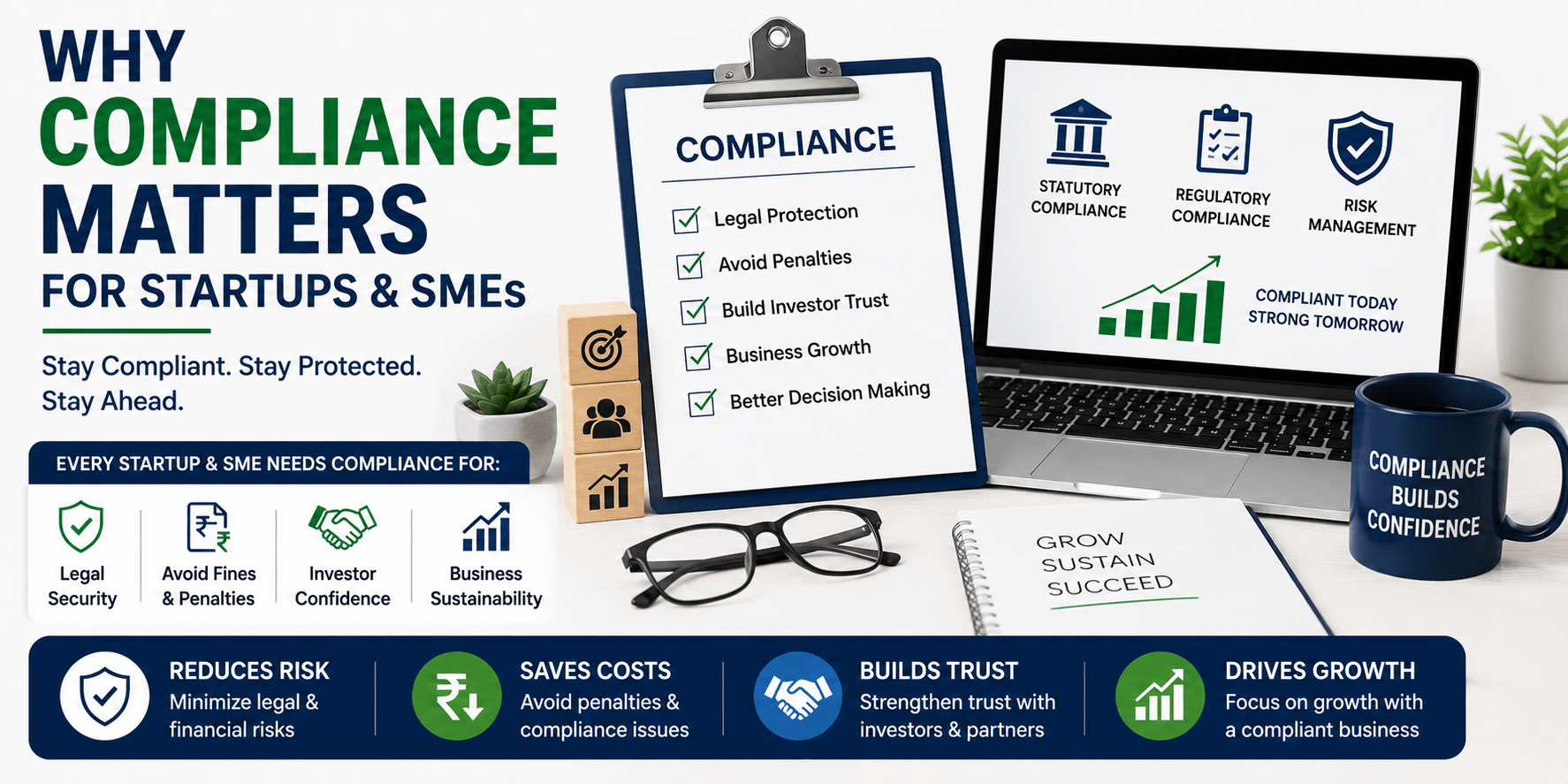
Starting and growing a business in India involves much more than just sales and operations. Today, startups and SMEs must also focus on proper business compliance to avoid penalties, maintain credibility, and ensure long-term growth.
Many entrepreneurs unknowingly ignore important legal and financial compliances during the early stages of business. This often leads to:
- GST notices
- ROC penalties
- Tax complications
- Legal risks
- Financial mismanagement
Whether you are a startup founder, small business owner, LLP, or private limited company, maintaining proper compliance is essential for smooth and sustainable business operations.
In this article, we will understand why compliance matters for startups & SMEs and how businesses can build a strong compliance framework in India.
What is Business Compliance?
Business compliance refers to following all legal, tax, financial, and regulatory requirements applicable to a business.
This includes:
- GST compliance
- ROC filing
- Income tax filing
- TDS compliance
- Accounting & bookkeeping
- Audit compliance
- Payroll compliance
- MCA regulations
Compliance helps businesses operate legally and maintain financial transparency.
Why Compliance is Important for Startups & SMEs
Many startups focus only on growth, funding, and customer acquisition. However, ignoring compliance can create serious long-term problems.
Proper business compliance helps:
- Avoid legal penalties
- Build investor confidence
- Improve financial discipline
- Maintain business credibility
- Support smooth operations
- Reduce business risks
For growing businesses, compliance is not just a legal requirement — it is a foundation for sustainable growth.
Key Reasons Why Compliance Matters for Startups & SMEs
- Avoids Heavy Penalties & Legal Issues
One of the biggest reasons startups and SMEs should focus on compliance is penalty prevention.
Late or incorrect filing of:
- GST returns
- ROC forms
- Income tax returns
- TDS returns
can lead to:
- Heavy penalties
- Interest charges
- Notices
- Legal complications
Non-compliance may also affect business reputation and operations.
Maintaining proper compliance helps businesses avoid unnecessary financial losses.
- Builds Business Credibility
A compliant business appears more trustworthy to:
- Customers
- Investors
- Banks
- Vendors
- Government authorities
Businesses with proper:
- Financial reporting
- GST compliance
- Tax filings
- ROC records
are considered more reliable and professional.
For startups planning expansion or funding, credibility plays a major role.
- Improves Investor Confidence
Investors prefer startups that maintain:
- Clean accounting records
- Proper compliance
- Financial transparency
- Organized documentation
Poor compliance can create red flags during:
- Due diligence
- Funding rounds
- Business acquisitions
Strong compliance systems improve investor readiness and business valuation.
- Ensures Smooth GST & Tax Compliance
GST compliance is one of the most important areas for Indian businesses today.
Proper compliance helps businesses:
- File accurate GST returns
- Claim Input Tax Credit (ITC)
- Avoid GST notices
- Reduce tax risks
Similarly, proper income tax compliance prevents:
- Tax disputes
- Assessment issues
- Penalties
Professional compliance management helps businesses stay financially secure.
- Helps Maintain Proper Books of Accounts
Compliance and accounting go hand in hand.
Businesses must maintain:
- Sales records
- Purchase records
- Expense tracking
- Bank reconciliations
- Payroll records
- GST invoices
Proper books of accounts help businesses:
- Track profitability
- Improve cash flow management
- Prepare for audits
- Make informed decisions
Strong accounting systems support better business growth planning.
- Reduces Business Risks
Growing businesses face multiple risks such as:
- Financial fraud
- Tax errors
- Operational inefficiencies
- Regulatory issues
Proper compliance systems reduce these risks by creating:
- Financial transparency
- Internal controls
- Reporting systems
- Monitoring mechanisms
This improves overall business stability.
- Mandatory for ROC & MCA Compliance
Private Limited Companies and LLPs must comply with various MCA and ROC filing requirements.
Important ROC compliances include:
- Annual returns
- Financial statement filing
- Director KYC
- Board resolutions
- Compliance reports
Failure to comply may lead to:
- Company penalties
- Director disqualification
- Legal action
Startups and SMEs should maintain a proper compliance calendar to avoid missing deadlines.
- Supports Better Financial Planning
Compliance-driven businesses usually maintain:
- Organized accounting records
- Proper financial reporting
- Tax planning systems
This helps businesses:
- Monitor expenses
- Control cash flow
- Improve profitability
- Plan future growth
Financial discipline is extremely important for startups and small businesses.
- Helps During Business Expansion
As businesses grow, compliance requirements also increase.
Businesses planning:
- Funding
- Expansion
- New partnerships
- Government tenders
- International operations
must maintain strong compliance records.
Non-compliant businesses often face delays and operational hurdles during expansion.
- Improves Long-Term Business Sustainability
Compliance creates structure and discipline within the organization.
Businesses with proper compliance systems are usually:
- Better managed
- Financially organized
- Operationally stable
- More scalable
Compliance is not an expense — it is a long-term investment in business sustainability.
Essential Compliance Areas for Startups & SMEs
Every growing business should focus on:
- GST registration & filing
- ROC compliance
- Income tax returns
- TDS filing
- Accounting & bookkeeping
- Payroll compliance
- Internal audit
- Financial reporting
A proper compliance system helps businesses operate smoothly and legally.
Final Thoughts
In today’s competitive and regulated business environment, compliance is essential for every startup and SME in India.
Ignoring compliance may create:
- Financial penalties
- Legal complications
- Investor concerns
- Operational disruptions
On the other hand, proper compliance management helps businesses:
- Build credibility
- Improve financial discipline
- Reduce risks
- Scale smoothly
- Achieve long-term stability
For growing businesses, compliance is not just about avoiding penalties — it is about building a strong foundation for success.